Showing posts with label equipment. Show all posts

Thursday, 14 May 2015

Oars

Today, we will talk specifically of one of the elements of equipment of rowing. It seems obvious, but the oars from our point of view are some of the most important materials in this sport. Without them, we could not could propel, which would be impossible to practice this sport. Why, then, we offer a detailed description of these:
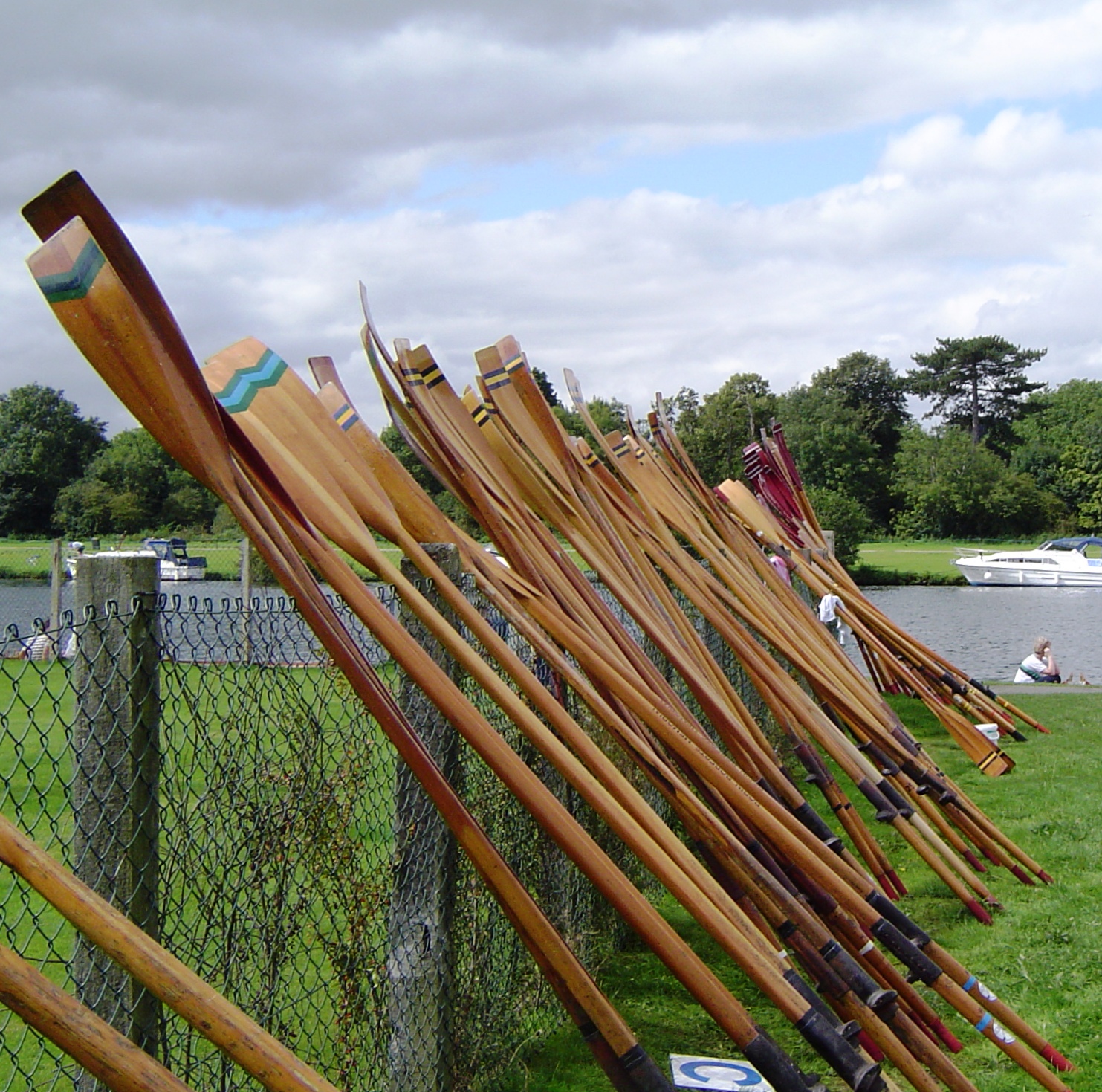


Oars are used to propel the boat. They are long (sculling: 250–300 cm; rowing 340–360 cm) poles with one flat end about 50 cm long and 25 cm wide, called the blade. Classic oars were made out of wood, but modern oars are made from more expensive and durable synthetic material, the most common being carbon fiber.


An oar is often referred to as a blade in the case of sweep oar rowing and as a scull in the case of sculling. A sculling oar is shorter and has a smaller blade area than the equivalent sweep oar. The combined blade area of a pair of sculls is however greater than that of a single sweep oar, so the oarsman when sculling is working against more water than when rowing sweep-oared. He is able to do this because the body action in sculling is more anatomically efficient (due to the symmetry).

The spoon of oars is normally painted with the colours of the club to which they belong. This greatly simplifies identification of boats at a distance. As many sports teams have logos printed on their jerseys, rowing clubs have specifically painted blades that each team is associated with.

Thursday, 7 May 2015

Rowing Equipment

Then we'd like to leave you a list of all possible Equipment that can be used in rowing. Here goes:


Blade
The flattened, or spoon-shaped, part of an oar that touches the water during rowing.

Boot
A device that holds the bow of a boat before a race, then drops below the water on the starting signal.

Bow
The forward section of a boat.

Bowball

A rubber ball attached to the bow tip of a shell to protect against damage and injury in case of a collision.

Button
A collar around the shaft of the oar that keeps the oar from slipping through the oarlock and can be adjusted up and down the oar to increase or decrease leverage.

Cox Box

An electronic device used by the coxswain to amplify his or her voice and broadcast it through speakers located throughout the shell.

Double
A sculling boat for two rowers.

Eight
A sweep-oar boat with eight rowers and a coxswain.


Fin
A small, flat piece of wood or plastic attached perpendicularly to the bottom of the shell to help the shell stay on a true course; also known as a "skeg".

Four
A sweep-oar boat for four rowers, with or without a coxswain.


Gate
A bar across the oarlock to prevent the oar from popping out.

Gunwale
A horizontal strip of wood running the length of a shell, to which the ribs and other parts traditionally are attached.

Handle
The part of an oar held by an oarsman.

Keel
The body of the shell that runs from box to stern.

Loom
The part of an oar between the blade and the handle.

Oar
A lever used to propel and steer a boat through water, consisting of a long shaft of wood with a blade at one end.

Oarlock
A U-shaped device on a boat's gunwale where the oar rests and swings; also called a "rowlock".

Outrigger
A framework attached to the shell and used to support the oarlock; also called a "rigger".


Pin
The metal rod upon which the oarlock is mounted.


Rib
A U-shaped piece of fabricated wood, aluminium or carbon fibre that supports the hull by fitting inside the shell between the keel and the gunwale.


Rigger
A framework attached to the shell and used to support the oarlock; also called an "outrigger".

Rowlock
A device on a boat's gunwale where the oar rests and swings; also called an "oarlock".


Rudder
A device under the shell of a boat used to steer it.

Scull
One of two short oars worked from side to side over the stern of a boat as a means of propulsion.

Shell
A rowing boat.

Skeg
A small, flat piece of wood or plastic attached perpendicularly to the bottom of the shell to help the shell stay on a true course; also known as a "fin".

Sleeve
The plastic jacket on the shaft of the oar upon which is mounted a button, used to secure the blade to the oarlock.